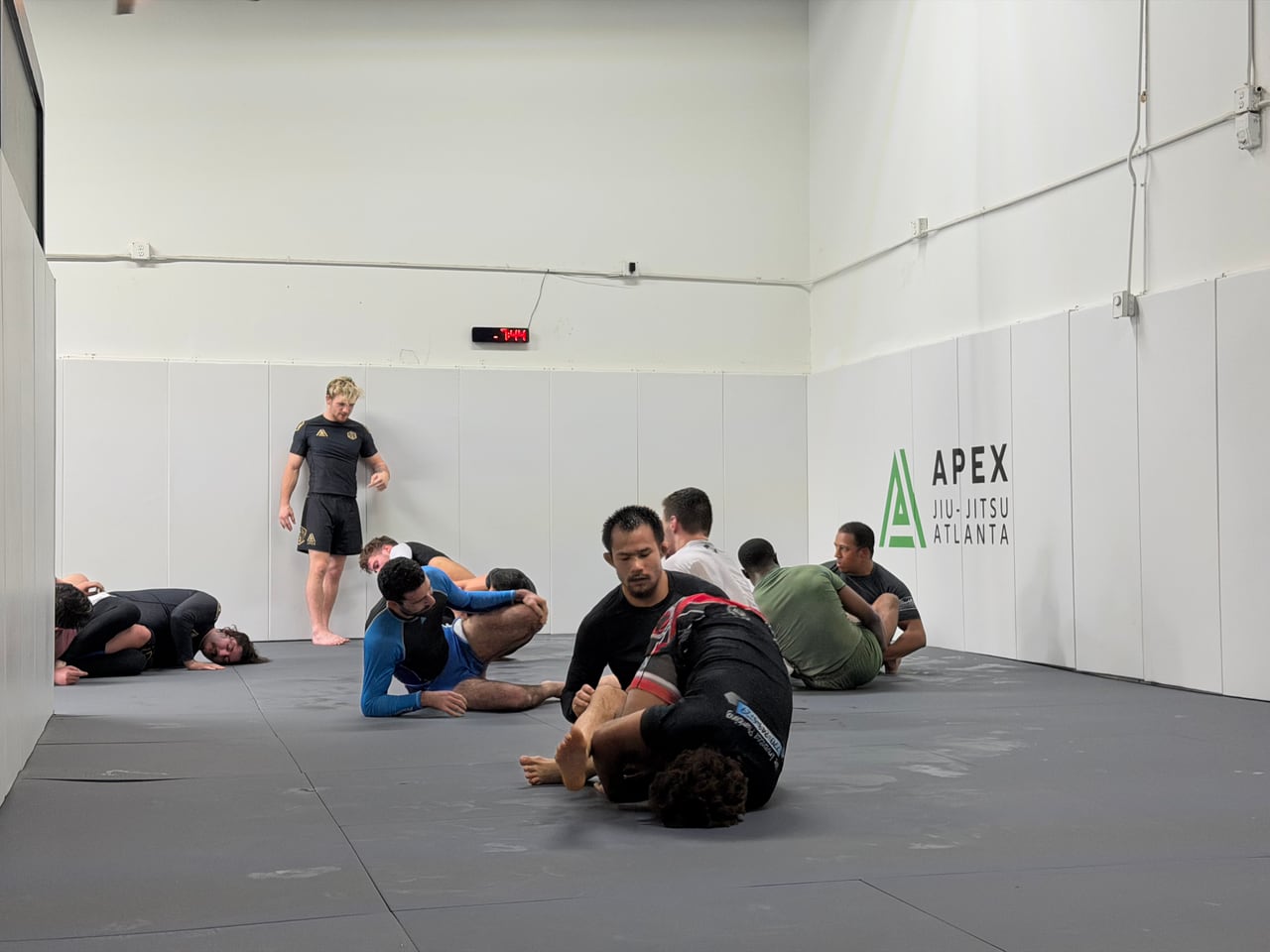
Do I need any experience to start?
None. Choose any class on the schedule as your first class, free. Tell us what you've done before when you book — even if the answer is nothing — and the coach on that night will know before you walk in.
Am I too old to start?
Almost certainly not, and the honest answer is more useful than the reassuring one. Age changes two things: how quickly you recover, and how much you can lean on speed. It doesn't change whether you can learn jiu-jitsu. If anything, the technical side of this sport rewards people who can't just muscle through a position — you're forced to learn the mechanics properly, and the mechanics are the part that still works in twenty years' time. It's one of the very few contact sports people take up in their forties and are still doing well in their sixties. Tell us your age and anything your body doesn't like when you book, and we'll pair you accordingly.
Do I need to be fit to start?
Absolutely not. In fact, jiu-jitsu is unusual in this regard — most people get tired in their first few sessions regardless of fitness level, because they're moving their body in ways they haven't before. Fit, unfit, somewhere in between: everyone arrives the same. You'll build the specific kind of fitness this sport asks for as you train. Most people find it happens faster than they expected. Fitness is something the training gives you. It isn't something you're expected to bring.
Will I be the worst person in the room?
On your first night, yes. So was everyone else on that mat, including both of us, and there's no arrangement of words that makes that untrue. What matters is what happens next. A coach is on the mat for every class, so nobody gets left in a corner to work it out alone. And being the least experienced person in a room where people know what they're doing isn't the problem — it's the fastest way to stop being that person. Nobody is keeping a table, either. Everyone in this sport is training with someone better than they are, all the way to the top of it.
I've seen your head coach's competition record. Is this room too advanced for me?
It's the reason to come, not the reason to stay away. Think about what that record actually means for someone on their first night: the person showing you how to hold a position knows exactly what it looks like when it works against the best grapplers in the world, so the version you get taught on a Tuesday isn't a watered-down approximation of it. That's the whole point.
And a competition record doesn't put you on the mat with him in a live round. It puts him next to you while you're learning the movement, in the room, alongside Elliot. What you'd actually experience is more attention than you'd get almost anywhere else, not less.
The one thing that genuinely matters is that we know you're new. Tell us when you book.
Which class should I book first?
Sunday 2:00–3:30pm is the free class. Owen coaches that slot. Tuesday or Thursday at 6:00pm is all-levels no-gi. Monday, Wednesday and Friday run 6:30–7:30am all-levels no-gi, 6:00pm no-gi technique, and 7:00pm no-gi live. Anyone 14 or older can start; under 14 is not permitted and the booking system will reject it.
How do you handle safety on the mat?
A few different ways. We have rules every member follows — no slams, for example, and others — that exist purely to keep training safe. We pair people thoughtfully, based on size, experience, and what they're working on. And we coach with risk in mind — when there's danger in a position or submission, we explain it as we're teaching it, not after.
There's one more thing worth saying, because it's the opposite of what most people assume. Control is a learned skill: knowing how much pressure a position needs and stopping exactly there. Two people who haven't learned it yet are the riskiest pairing in any gym. That's most of the argument for being taught correctly from night one rather than being left to figure it out among other new people — sloppy technique is what hurts people, so teaching the correct mechanic on day one is a safety decision before it's a coaching one.
Jiu-jitsu, like any sport, carries a small risk of injury — but we focus on smart training and minimizing risk wherever we can. We have a duty of care to every member, and we want our students to be able to keep training. That's what all of this is for.
Do you run gi classes?
No. Every class we run is No-Gi. It's the faster, more open version of the sport, it's what our head coach competes in at the highest level, and it's what you see at the world championship of no-gi grappling. There's no gi to buy and no uniform to order.
What should I wear to class?
Wear shorts or leggings with a rash guard or close-fitting athletic shirt. Choose clothing without zippers, pockets, or anything sharp, and bring water.
What's the weekly timetable?
Monday, Wednesday and Friday: 6:30–7:30am all-levels no-gi, 6:00pm no-gi technique, and 7:00pm no-gi live. Tuesday and Thursday: 6:00pm all-levels no-gi. Sunday: 2:00–3:30pm free class. Saturday is closed.
Do you run self-defense classes?
Self-defense is not part of our weekly class schedule. We host focused self-defense workshops in Chamblee as periodic events. Call us at +1 470-974-0963 for the next announced date.
What does it cost, and how do I join?
Your first class is free. After that, memberships are month-to-month: Lite is $120 a month, Unlimited is $165 a month. Joining fees are waived.
To join, create an Apex account, verify your phone, choose a plan, sign the waiver, and pay. Book your first class free if you haven't trained with us yet. There's no sales appointment and nothing to sit through.
Is there a contract?
No. Memberships are month-to-month. You can cancel any time, no exit fees, no awkward conversations.
What happens if I can't make every class my plan allows?
Nothing — your membership is the price you pay for access, not a contract requiring you to attend a set number of times. Some weeks you'll come more than your plan suggests, some weeks less. It evens out.
What's the easiest way to book a class?
If you're new, book your first class free and choose any class on the schedule. Existing members use Apex Member USA to book, cancel, or join a waitlist.